
What is corporate improv and how can it help teams at work?
Corporate improv uses improvisation exercises and training methods to help people practise communication, collaboration and adaptability at work. It can take the form of a conference energiser, a team-building workshop or a longer leadership development programme. No acting experience is needed, and nobody has to be funny.
Ask a dozen people what corporate improv is, and you’ll get a dozen different answers, and probably a few emotional reactions!
For some, it’s a burst of energy at a conference or a memorable away-day activity. For others, it’s a communication skills workshop or a serious leadership development tool.
And everyone is right. Corporate improv covers a whole spectrum of experiences. Understanding that spectrum helps you choose an approach that fits your team and your learning and development goals.
It’s practical, supportive group learning, with plenty of opportunities to enjoy yourself along the way.
In this article, we’ll map that spectrum, explain the skills and techniques involved, and show what improv in the workplace looks like in practice.
But first, let’s address a familiar question: how will your team feel about the word “improv”?
How comfortable is your organisation with the word “improv”?
Some teams see the word improv on an invitation and can’t wait. For others, it conjures forced performance and public embarrassment, and half the room has mentally called in sick before the session is booked.
As a learning and development (L&D) professional, you might already see its potential but feel wary of booking something that could leave colleagues uncomfortable.
That concern is useful information when designing a session. The framing matters: a workshop might be introduced as communication training, team development or creative problem-solving, with improvisation explained as the method used to practise those skills.
We’ll help you introduce the session in language that fits your organisation, explaining what participants can expect and why the exercises are useful.
We can also work with you on the content, pace and ways people participate, supporting everyone to engage at a manageable level of challenge.
Corporate improv as a tool for workplace communication
Improvisation is the practice of creating something with other people, in the moment, without a script. Strip away the theatre and that describes much of working life. Meetings, client calls, negotiations and presentations that go off-piste all involve responding to something you couldn’t fully prepare for.
Corporate improv takes the methods improvisers use to practise unscripted collaboration and applies them to workplace communication.
Because that idea is flexible, it helps to see the full range.
Improv-inspired fun
Warm-ups, icebreakers and energisers get a room laughing, connecting and awake. Think of a punchy fifteen minutes at the start of a conference day. The goal is energy and connection, and there’s plenty of value in that.

One-off team events
A team spends an afternoon playing together, discovers colleagues in a new light, and has opportunities to strengthen relationships.
Sessions like our teambuilding through improvisation sit here: fun first, with opportunities to practise listening, collaboration and mutual support along the way.
Targeted workshops
Some workshops focus on a specific communication task, such as presentations, public speaking and networking, effective online meetings or collaborating better at work.
Others explore the capacities people need in complex, fast-moving environments: resilience, flexibility and the ability to adapt when the plan changes. Sessions like innovation and ideation sit here.
Both kinds can be playful and enjoyable, with each exercise chosen for the skills it helps participants practise.
Sustained, tailored programmes
Improvisation can also support more sustained development work: leadership programmes such as the improvised leader, improvisation skills for trainers and coaches, and longer-term work on team culture.
Here, exercises are woven into a programme designed around specific goals, with opportunities to practise between sessions and reflect on what happens at work.
None of these is more or less “corporate improv” than another. The useful question is where your team’s needs sit on the spectrum, and which format gives you the best opportunity to address them.
The role of improvisation skills in business
Why do improvisation skills matter in business? Because improvisers deliberately practise qualities that help people work together when they don’t know exactly what will happen next.
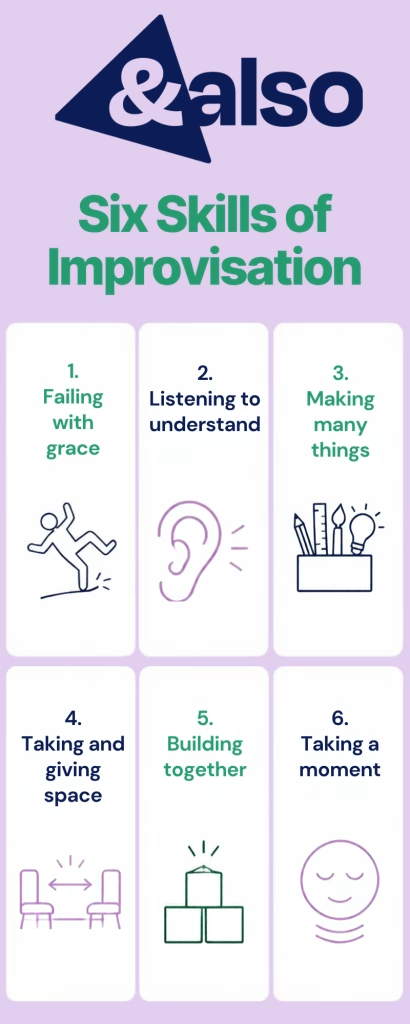
At AndAlso, we build our training around our Six Skills of Improvisation model.
Failing with grace: Improvisers treat mistakes as inevitable and useful; something to notice, learn from, and move past. Practising this in a low-stakes setting can help people recover more confidently when things don’t go to plan.
Listening to understand: Improvisers respond to what their partner actually says. That calls for a quality of listening many of us could practise more: listening to understand, rather than listening while waiting to speak.
Making many things: Improv encourages generating freely without immediately self-censoring: many ideas, quickly, before judging them. It’s a useful approach to the early stages of problem-solving, when an idea needs room to develop.
Taking and giving space: Knowing when to step forward and when to make room for others. It combines presence and generosity: contributing when it’s your moment, and actively supporting someone else when it’s theirs.
Building together: Treating a colleague’s contribution as something to explore and build upon. It helps groups develop ideas together and notice possibilities they might otherwise miss.
Taking a moment: The improviser’s habit of bringing back what came earlier: the idea from twenty minutes ago, or the point a quiet colleague made that the room moved past. It’s a practical way to show you’ve listened and keep useful contributions in play.
These skills underpin familiar workplace challenges: presenting flexibly, negotiating while listening, leading through uncertainty and responding when the plan keeps changing.
Business benefits of improv training
Organisations come to corporate improv training with different goals, but some themes appear regularly.
Better communication: Practising attentive listening and clear responses can help teams identify misunderstandings and communicate more thoughtfully with clients and colleagues.
Stronger collaboration: Exploring a colleague’s contribution and building on it gives teams a practical way to rehearse working together. Participants practise sharing attention, supporting ideas and making room for different voices.
Increased confidence: As the challenge in a session builds gradually, people have opportunities to try something unfamiliar with support. Speaking up, thinking on your feet and contributing without over-preparing can begin to feel more manageable.
Creative problem-solving: Improv exercises encourage quantity and momentum before perfection. Generate first, judge later — giving ideas a chance to develop before deciding which ones to pursue.
Team connection: Playing together gives colleagues a shared experience and a chance to see one another differently. You can hear about participants’ experiences in our workplace improv testimonials.
Key improv techniques for business teams
The exercises vary enormously, but many improv techniques for business draw on a handful of core practices.
Active listening: Exercises encourage participants to respond to what they actually hear, rather than prepare their next contribution in advance. Everything else builds on this attention.
Accepting offers: In improv, anything a partner contributes is an “offer”. A common approach is to accept it and add to it, often summarised as “yes, and”. At work, this means exploring a contribution before judging it — it doesn’t mean agreeing with every suggestion or abandoning your judgement.
Storytelling: Building narratives together gives participants opportunities to practise clear, engaging communication, with applications in presentations, pitches and leadership.
Status work: Improvisers explore how status is signalled through posture, voice and behaviour. For professionals, this offers a way to examine how they read the room and communicate authority, openness or approachability.
Group problem-solving: Whole-group exercises depend on shared attention and mutual support. Teams experience different ways of collaborating, then discuss how those habits might apply at work.
If you’d like to explore the thinking behind these techniques, read our core concepts of improvisation.
Building confidence, listening and adaptability at work: what the research shows
The value of business improv training extends beyond any single exercise. It gives people a space to practise how they respond to uncertainty, unfamiliar contributions and unexpected challenges.
Being put on the spot, changing direction mid-flow or recovering from a mistake are all familiar workplace experiences. An improv session offers opportunities to rehearse them with lower stakes and support from others.
Research offers encouraging evidence for some of these benefits. Randomised experiments found that brief improvisation activities improved divergent thinking and tolerance of uncertainty compared with matched non-improvisation activities [1].
Research with student teachers also found improvements in self-reported confidence following improvisation training. In a follow-up study, self-reported performance confidence — one component of interpersonal confidence — remained higher relative to a control group one year later [2].
These findings are encouraging, although they don’t establish that every corporate workshop will produce the same results. The participants, programme design and opportunities to apply the learning all matter.
Making room for mistakes and questions
Improvisation gives people opportunities to notice mistakes, respond to them and carry on together.
Practising these habits can help people feel more able to share early ideas, admit uncertainty and ask questions. Those behaviours are relevant to psychological safety in teams.
A review by Harvard Business School researchers highlights the role psychological safety plays in helping organisations learn and perform in dynamic environments [3]. That research provides useful context for this work; it does not, by itself, demonstrate that improv training creates psychological safety.
Paying attention to how teams collaborate
Research on collective intelligence also highlights the importance of group collaboration. An analysis covering 22 studies and 1,356 groups found that collaboration processes were more important in predicting collective intelligence than the skills of individual members [4].
This was research into group performance, rather than an evaluation of improv training. It helps explain why paying attention to how people work together is valuable.
These questions matter across an organisation, from graduate cohorts to executive and high-performing teams. A new starter might practise finding their voice; a senior leader might focus on listening, presence or responding to incomplete information.
Business improv training in practice
What a session involves depends on its purpose and where it sits on the spectrum.
Conference sessions and takeovers
At the event end of the scale, this might be a fifteen-minute energiser or a guided networking session that gets strangers talking.
At its fullest, it’s a conference takeover: we MC the day and connect warm-ups, energisers and short sessions to the conference’s theme.
If the event is about resilience, adaptability or responding to an uncertain future, improvisation can give participants a practical experience of those ideas.
Everything from a single energiser to a full takeover comes under our conference support services.

Standalone workshops
Standalone workshops are a common format for team days and targeted skills sessions. A typical workshop moves through four stages:
- Warm-ups: Short, low-pressure exercises that help people arrive, connect and get out of email-brain.
- Group exercises: Paired and small-group activities chosen for the skills your team wants to develop, with the challenge increasing gradually.
- Reflection: The bridge from the exercise room to the office. What did we notice? Where does this show up at work? What could we try differently?
- Practical takeaways: Habits and techniques people can test in their next meeting, presentation or difficult conversation.
Sessions are designed to be supportive and inclusive, with attention to participants’ needs and different levels of confidence. Improv is for introverts, extroverts and people who aren’t sure which camp they’re in.
We’ve written about what to expect in a workplace improv session for anyone who would like a clearer picture before joining in.
Sustained programmes
A sustained programme is designed around your organisation’s goals and delivered over a series of sessions.
Each workshop builds on the last. The listening practised early in the programme becomes a foundation for later collaboration and leadership work.
Between sessions, participants test what they’re learning in meetings, presentations and everyday challenges, then bring their experiences back into the room. This creates opportunities to reflect, adjust and practise again.
To see an example, read our case study on women’s leadership development with a global luxury organisation.
And if you’d like to try the approach yourself, you can join one of our monthly online sessions. No preparation is needed, and nobody will ask you to be funny.

AndAlso’s approach to improv in the workplace
At AndAlso, we deliver across the whole spectrum, adapting the format to your goals, context and team.
Our trainers are working improvisers who perform regularly, bringing practical experience of listening, collaboration and responding in the moment to their facilitation.
We deliver improvisation in the workplace for organisations across the UK and internationally, from one-off events to sustained programmes and individual coaching, online and in person.
Our popular programmes cover common needs, and sessions can be tailored or built from scratch around your team.
Wherever your needs sit on the spectrum, we aim to make the learning supportive, practical and enjoyable, with a clear connection to what happens back at work.
What would you like your team to do differently?
Listen more closely? Speak with more confidence? Find a better way through change?
Tell us what you’re working on, and we’ll help you explore whether improvisation training is a good fit.
Tell us about your team’s needs by email OR Book A Discovery call with one of our team
FAQs about corporate improv
What is corporate improv?
Corporate improv uses improvisation exercises and training methods to practise workplace skills. It can include conference energisers, team events, communication workshops and sustained leadership development programmes. No acting experience is required, and nobody has to be funny.
How is improv used in business?
Improv is used in conference sessions, team-building days, presentation and communication workshops, leadership development and coaching. Exercises give participants opportunities to practise listening, collaboration and responding to uncertainty, followed by reflection on how those skills apply at work.
Do you need acting experience for corporate improv classes?
No. Sessions are designed for people with no previous improv experience. Activities build gradually, and facilitators support different levels of confidence and ways of participating.
What are the benefits of improv at work?
Improv training can support communication, collaboration, confidence, creative problem-solving and adaptability. It also gives colleagues a shared experience and opportunities to connect. The benefits depend on the session’s goals, design and how participants apply what they practise.
What skills does business improv training develop?
Business improv training gives people opportunities to practise active listening, clear communication, storytelling, presentation skills and collaborative problem-solving. It can also help participants explore how they respond to mistakes, uncertainty and changing plans.
Is improv training suitable for senior teams?
Yes. Senior teams can use improv training to explore listening, presence, collaboration and decision-making under uncertainty. Sessions can be tailored to leadership contexts and specific team challenges.
Can improv training be delivered online?
Yes. Online sessions offer ways for remote teams to practise listening, collaboration and communication across locations. Activities are adapted for the online setting, with opportunities to participate and reflect together.
Research and references
[1] Felsman, P., Gunawardena, S. and Seifert, C. M. (2020). Improv experience promotes divergent thinking, uncertainty tolerance, and affective well-being. Thinking Skills and Creativity, 35, 100632.
Read the study.
[2] Seppänen and colleagues (2021). Validated Interpersonal Confidence Questionnaire to Measure the Impact of Improvisation Training. This paper includes a one-year follow-up examining self-reported confidence following improvisation training.
Read the paper.
[3] Edmondson, A. C. and Bransby, D. P. (2023). Psychological Safety Comes of Age: Observed Themes in an Established Literature. Annual Review of Organizational Psychology and Organizational Behavior, 10, 55–78.
Read the review.
[4] Riedl, C., Kim, Y. J., Gupta, P., Malone, T. W. and Woolley, A. W. (2021). Quantifying collective intelligence in human groups. Proceedings of the National Academy of Sciences, 118(21), e2005737118.
Read the study.
Keep exploring
- Improv in the workplace
- What to expect in a workplace improv session
- Women’s leadership development: an applied improvisation case study